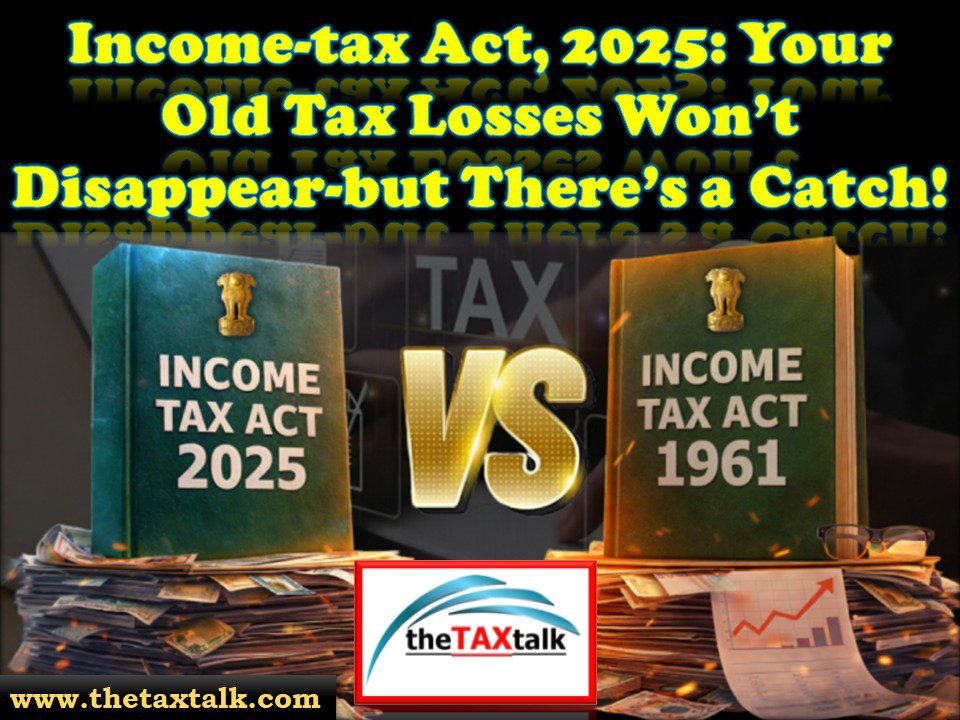

Income-tax Act, 2025: Your Old Tax Losses Won’t Disappear-but There’s a Catch!
The Income-tax Act, 1961 has been replaced. But what happens to tax losses accumulated under the old law?
Can a business loss incurred under the Income-tax Act, 1961 still be carried forward and set off after the Income-tax Act, 2025 comes into force?
The answer is yes—subject to the applicable conditions.
The transition to the new law does not wipe out eligible brought-forward losses. However, taxpayers should not assume that the new Income-tax Act gives these losses a fresh lease of life.
Old losses continue, but their original eligibility and carry-forward period continue to matter.
This is particularly important while preparing returns for Tax Year 2026–27 and subsequent years.
What Changed From 1 April 2026?
The Income-tax Act, 2025 came into force on 1 April 2026, replacing the Income-tax Act, 1961.
While the structure and numbering of provisions have changed substantially, the fundamental framework relating to set-off and carry-forward of losses remains broadly similar.
The important question, therefore, is not merely:
«“What is the section number under the new Act?”»
The more important question is:
«“Was the loss eligible under the old law, and is its original carry-forward period still available?”»
Old Law vs New Law: Loss Provisions
The corresponding provisions can broadly be understood as follows:
Particulars| Income-tax Act, 1961| Income-tax Act, 2025
Intra-head set-off| Section 70| Section 108
Inter-head set-off| Section 71| Section 109
Business loss| Section 72| Section 112
Capital loss| Section 74| Section 111
Speculation loss| Section 73| Section 113
Specified business loss| Section 73A| Section 114
Racehorse activity loss| Section 74A| Section 115
Thus, although the section numbers have changed, the underlying concept of carrying forward eligible losses has not simply disappeared with the repeal of the 1961 Act.
How Long Can Tax Losses Be Carried Forward?
Broadly, the carry-forward periods continue to operate according to the nature of the loss and the applicable statutory provisions.
Business Loss
An eligible normal business loss can generally be carried forward for up to eight tax years.
Capital Loss
Eligible capital losses can generally be carried forward for up to eight tax years.
Speculation Business Loss
A loss from speculation business can generally be carried forward for up to four tax years, subject to the applicable conditions.
Racehorse Activity Loss
Loss relating to the activity of owning and maintaining racehorses can generally be carried forward for up to four tax years, subject to the statutory requirements.
The important point is that the clock does not restart merely because the new Income-tax Act has come into force.
Example: An Old Business Loss
Suppose a taxpayer incurred an eligible business loss in Assessment Year 2023–24 under the Income-tax Act, 1961.
The taxpayer may continue to carry forward that eligible loss under the transitional provisions of the Income-tax Act, 2025, subject to the applicable conditions.
But the taxpayer cannot say:
«“The new Act started on 1 April 2026, so I have received a fresh eight years to use my old loss.”»
That is not how the transition works.
The original carry-forward period remains relevant.
Therefore, taxpayers should maintain a year-wise reconciliation of brought-forward losses rather than simply carrying forward the figure appearing in the previous year’s computation.
Section 536: The Transitional Safety Net
One of the important provisions in this regard is Section 536 of the Income-tax Act, 2025, dealing with repeal and savings.
The repeal of the Income-tax Act, 1961 does not mean that every right, liability or proceeding arising under the old law simply disappears.
The saving provisions preserve eligible brought-forward losses, subject to the conditions prescribed under the new law and the original limitations applicable to those losses.
This is crucial because a taxpayer’s loss history can span several years, while the statutory framework governing the return may have changed in the meantime.
Three Critical Points Taxpayers Must Remember
1. Late Filing Can Cost You a Tax Benefit
Certain categories of losses can be carried forward only when the return of loss is furnished within the prescribed due date.
Therefore, if a taxpayer lost the right to carry forward a particular loss because of non-compliance with the filing requirement under the old law, the new Income-tax Act does not automatically revive that lost benefit.
A new Act does not mean a new opportunity to correct an old default.
Taxpayers should therefore verify the original return-filing history of every brought-forward loss.
2. Capital Losses Have Their Own Restrictions
Capital losses are subject to specific rules regarding their set-off.
Broadly:
– A short-term capital loss can be set off against eligible short-term as well as long-term capital gains.
– A long-term capital loss can generally be set off only against eligible long-term capital gains.
Therefore, merely having a large brought-forward capital loss does not mean that it can be adjusted against every type of income or gain.
The character of the loss and the nature of the current year’s capital gains must be examined.
3. House Property Loss Has Separate Rules
Loss from house property is also governed by specific set-off and carry-forward provisions.
The maximum house-property loss that can generally be set off against income under other heads in the same year remains ₹2 lakh, subject to the applicable provisions.
The balance loss may be carried forward for subsequent years, subject to the statutory conditions.
Therefore, taxpayers should distinguish between:
loss carried forward and loss actually available for set-off in the current year.
These are not necessarily the same thing.
What Does the New Act NOT Do?
The Income-tax Act, 2025 does not provide a blanket mechanism under which every old tax loss gets a fresh life.
For example, it does not automatically:
– revive a loss that was never eligible for carry-forward;
– extend the original carry-forward period indefinitely;
– convert one category of loss into another;
– remove the conditions applicable to set-off; or
– restore a loss whose carry-forward was lost because of non-compliance under the old law.
This distinction is extremely important for tax planning.
Why Should Businesses Reconcile Old Losses Now?
The transition to the new Income-tax Act provides a good reason to undertake a complete loss reconciliation.
A taxpayer may have losses originating from several years, each with a different expiry period and different conditions for utilisation.
For example, a business may have:
– normal business loss;
– unabsorbed depreciation;
– speculation loss;
– capital loss;
– specified business loss; and
– house-property loss.
Each category has its own rules.
A single figure titled “Brought Forward Loss” in an old computation is therefore not sufficient.
A Practical Loss Reconciliation
Before filing the return for Tax Year 2026–27, taxpayers and professionals should prepare a year-wise statement showing:
Assessment/Tax Year → Nature of Loss → Original Amount → Amount Utilised → Balance → Years Already Carried Forward → Remaining Period → Conditions for Set-off
This simple exercise can prevent errors in the new tax regime.
Can an Old Loss Be Set Off Under the New Act?
Yes, where the loss is eligible for carry-forward and has not exhausted its permissible carry-forward period, the transition provisions allow the eligible loss to continue.
However, the set-off must be made in accordance with the provisions applicable to that category of loss.
Therefore, the transition should not be viewed as a complete break between the two laws.
It is better understood as a continuity mechanism for eligible rights and liabilities arising under the earlier law.
What Should Tax Professionals Check?
For every brought-forward loss, professionals should verify at least the following:
1. Original Year of Loss
Identify exactly when the loss arose.
2. Nature of Loss
Determine whether it is a normal business loss, capital loss, speculation loss, specified business loss, house-property loss or another category.
3. Original Eligibility
Check whether the loss satisfied the conditions for carry-forward under the Income-tax Act, 1961.
4. Timely Filing
Verify whether the return was filed within the prescribed time wherever timely filing was a condition for carry-forward.
5. Utilisation in Earlier Years
Reconcile the amount actually set off in each subsequent year.
6. Remaining Carry-Forward Period
Calculate the remaining period based on the original year of loss, rather than assuming that the new Act resets the clock.
7. Set-Off Restrictions
Check whether the particular loss can be set off against the income or gains of the current year.
8. Transitional Provisions
Ensure that the loss is properly carried into the new statutory framework in accordance with the saving provisions.
The New Act Changes the Numbers—Not the History
One of the practical challenges of the Income-tax Act, 2025 is that professionals and taxpayers will now have to work with two different sets of section numbers while dealing with historical transactions.
For example:
Section 72 of the 1961 Act → Section 112 of the 2025 Act
Section 74 of the 1961 Act → Section 111 of the 2025 Act
But the change in section numbering does not rewrite the history of the loss.
The year in which the loss arose, its original nature, its eligibility and the period for which it could be carried forward remain important.
A Simple Message for Taxpayers
If you have old tax losses sitting in your tax computation, don’t simply copy the closing balance into the first return under the new Income-tax Act.
Reconcile it.
Check where it came from, whether it was legally eligible, how much has already been utilised and how much time remains.
This is particularly important where a taxpayer has undergone business restructuring, changes in ownership, mergers, demergers or changes in the nature of business, because additional statutory conditions may become relevant.
The Takeaway
The replacement of the Income-tax Act, 1961 by the Income-tax Act, 2025 does not wipe out eligible brought-forward tax losses.
But there is an important catch:
The new Act does not give old losses a fresh lease of life.
An eligible loss can continue, but its original carry-forward period and statutory conditions remain relevant.
Therefore, before filing the first return under the new Income-tax Act, every taxpayer with significant brought-forward losses should undertake a proper year-wise reconciliation.
Old losses are not dead. But they are also not immortal!
Key Provisions
Income-tax Act, 1961: Sections 70, 71, 72, 73, 73A, 74 and 74A.
Income-tax Act, 2025: Sections 108, 109, 111, 112, 113, 114 and 115.
Transitional provision: Section 536 of the Income-tax Act, 2025.
Disclaimer: This article is intended for general tax awareness and educational purposes. The precise availability and set-off of any brought-forward loss must be determined after examining the relevant year’s law, filing history, nature of the loss and applicable transitional provisions.

